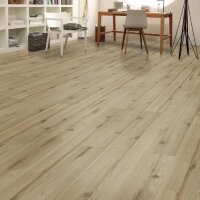
 Solid parquet is a model consisting entirely of valuable trees. Its structure is layered and homogeneous.
Its raw material is draft logs brought from Africa and the Far East. Since their resistance levels are long, leafy varieties are preferred. There are also local productions. Wood species such as Maple, Beech, Walnut, Teak and Bamboo are used in its construction.
This parquet type has a scraper margin of 6 millimeters. It can be cleaned and varnished approximately 8 times. The time required for scraper depends on usage. However, it is recommended to be done every 5 years. In other words, it can be said that the life of a floor is 40 years. It can be used for a very long time in line with the necessary maintenance.
Some growers grow the trees exclusively to ensure the continuity and quality of the flooring. At the same time, thanks to this method, they prevent damage to the environment. It will be the healthiest method to pay attention to the producers to have the necessary documents and to work with reliable brands.
What are the Advantages of Solid Parquet?
It is a natural parquet type.
It is healthier than other flooring.
It has an aesthetic appearance.
It is used for a long time.
It makes sound and heat insulation.
Polish can be applied.
It is a recyclable product.
What are the Disadvantages of Solid Parquet?
Although it is an old method, it is an expensive product.
After its installation, the time it becomes usable for the space is quite long. (About 10-15 days.)
It causes swelling in cases such as waterlogging. Its renovation is very troublesome; the entire floor may need to be changed.
If there is deformation in some areas, even if that area is repaired locally, the difference between it and other regions will be evident. After the area is repaired, a general sanding and polishing process should be done.
It is affected by humidity and temperature change; There are openings between the parquets.
How to Repair Solid Parquet?
The use of solid parquet requires some necessary maintenance, as is the case with every parquet. There are some trics that should be done especially in case it gets damaged or before it gets damaged.
What to Do in Case of Flooding
Flooding is the most irreversible situation for solid parquet. If the entire pavement area is flooded, the only action that can be taken is to replace all of the skins.
With a certain coverage area seeing water, it can continue to be used by changing only the part affected by this situation.
However, in both cases, it must be ensured that the floor to be coated is completely dry. The floor that looks dry from the top can ruin your parquet by preventing it after coating.
The coating, which is completely affected by water, never gets its old shape even if it is tried to be dried. If twists or trenchs have occurred, you won’t be able to get its old performance back from your parquet.
What to Do in Case of Scratch
In cases such as scratching, the situation can be compensated by making scraper (It is the process of smoothing and polishing the surface by sanding the wooden parquet flooring and filling the gaps between the parquet.). However, this application is not a highly desirable method in newly furnished areas. Scratching the entire area for a local scratch is not a very logical solution.
Retouching pencils are also a method that can be used for scratching. With a pen suitable for the color of the drawn area, the resulting color separation can be closed. By applying a semi-matte polish to the painted area, you can make your parquet look smoother. However, this method will not make your flooring look like new either.
 Flooring Systems